
What Nobody Told Me About Being Induced
In my nearly 10 years of birth work, I have heard so many variations of birth stories. I started to notice a pattern with some of the stories I was hearing that made me question if women really understood what they were agreeing to when accepting an induction to start labor. Having my first birth experience begin with an induction, I noticed trends and commonalities across the board.
Induction uses methods including medicinal or physical procedures to start the labor process. Common methods of induction in the United States include: cervidil or foley bulb catheter for cervical ripening, Pitocin through IV to produce consistent contractions, amniotomy - tearing of the amniotic sac to start contractions, and/or membrane sweep at the opening of the cervix to get contractions to begin. In many cases, multiple methods may be used in a sequence to mimic the process of labor.
A little backstory on my first birth…
It was the day before Thanksgiving and I am currently 2 days past due date. I go in for my scheduled appointment and received an ultrasound. My doctor then told me that the amniotic fluid around my baby was low and asked me how I felt about an induction. I didn’t really ask extra questions about this because I was aware that the baby needed the fluid to survive. I felt like this was a safe option and I should be able to continue with my (mental) birth plan going through this process…
So I go over to the hospital, excited to meet my baby. After all, I did say she was going to come on Thanksgiving, early enough for me to have dinner - and I had everything I needed at the doctor’s appointment with me. I even did my make-up before the appointment incase I had the baby that day. I felt so ready. Shortly after I get checked in, I get hooked up to the monitors: one that determines contraction patterns and the other that monitors baby’s heart rate. To my surprise, the nurse says, “you’re contracting. You don’t feel that?”
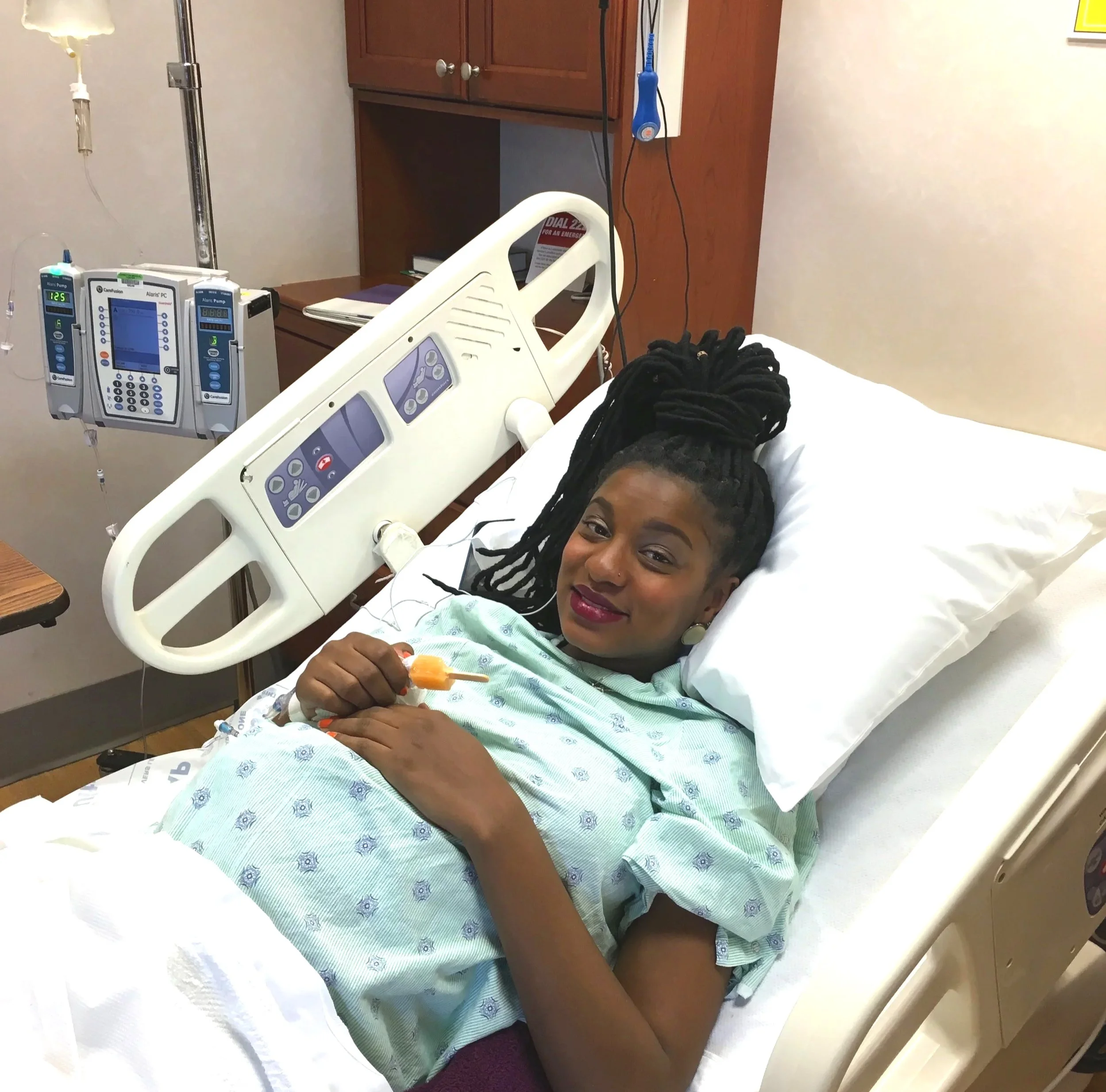
Pictured here is me during my first birth, very early after check-in at the hospital when I was told I was already contracting. There are many layers to inductions and not all induction processes are created equally. Augmenting birth through interventions does not run a linear path for experiences.
Nothing. I felt nothing. (Maybe this is why they say black women are so strong?) But this is physiological labor. What was happening in my body was very normal. My body was beginning the labor process, and managing it with how I was flowing. I’m almost certain I would have started to feel those contractions that night if I were to just go home and rest, but instead I felt coerced into accepting the induction.
The doctor on duty at that time of my induction was not my doctor - a white male - but another black woman that I thought would be great for me to trust. She comes in to tell me that she’s there to administer my cervidil, which is basically like a tampon coated with a slow-releasing, synthetic prostaglandin. Prostaglandins are a group of lipids that produce hormone-like reactions in the body - one of which is the stimulation of uterine contractions and ripening of the cervix. So anyways, I tell the doctor:
Me: I was told that I was contracting already. Can I let my body just do what it’s doing naturally and skip the induction?
Doctor: Well Doctor _ already put in the order in for the induction so we need to just do it.
Me: Ok…
Doctor: This will stay in for up to 12 hours, or until you start to feel contractions. Then we’ll begin the next phase with Pitocin.
Young and impressionable, I just went along with it; Not being fully aware of the risks and challenges I was soon to face with an induction. It was from there that I learned for myself what nobody told me, that…
Induction does not mean an easier path to labor.
I think initially I thought that induction would just be some controlled process that would easily flow in a timely manner for baby to arrive. I was so wrong. It took 9 months for my baby to grow, and the time it takes bringing them earthside is no short process. It should not be rushed and the divine flow should be allowed to take place. Trying to make this process happen in some time other than what baby, and the body, has determined as the right time can create a more difficult path.
Some may beg to argue, but those who have experienced physiological labor and birth can share that there are many times when the process follows its own ebbs and flows to bring baby through. The labor is not always some long, drawn out process. Sometimes, it slows down or feels painless while still making its progress. When natural oxytocin is able to flow and the woman feels mentally safe for the labor, labor can move very quickly with minimal discomfort. The body will always take moments for rest as needed. Which brings me to this next thing that I wish I fully understood before my induction and that’s that…
Pitocin-induced contractions don’t feel the same as Oxytocin-induced contractions.
I fully understood this part after I had my home births. Not only does pitocin not have the same effect as natural oxytocin on getting labor flowing, but the body doesn’t even respond to them in the same manners. To break it down simply, Pitocin is the artificially created oxytocin. In chemical structure, they look the same but the way they react in the body is different. During labor, oxytocin rises in both the blood and the brain, where it is able to reduce pain, anxiety, and stress. Pitocin on the otherhand is administered through the IV, and unable to cross the blood-brain barrier so it doesn’t provide the same responses in the body. This can make Pitocin augmented labors last longer and be more intense.
Being induced often leads to other interventions.
Pitocin-induced labor was so intense for me, that eventually I began to get so tired while my body was being told to contract every 2 minutes. This went on for a number of hours before I opted for some IV pain medication - nubain. Again, I was not fully made aware of all of the side-effects and possibilities that this extra intervention would bring. I was only told that the first dose would be the strongest, but it should allow me to get some rest. WRONG. ABSOLUTELY NOT. As the drug was injected into my IV, I instantly felt the heaviness of sleep come over me. I closed my eyes and leaned my head over... BOOM! Another 2 minutes go by and here we are, I am back up fighting through contractions except now, I’m miserably trying to stay awake through them. After more than an hour of this, I opted for an epidural. There was no way I was going to have energy to push as things were happening in that time.
One intervention after another.
I’ve seen this go a number of ways as well and not all inductions have progressed for a baby to arrive less than 24 hours. All this to say, if you’re aiming for a birth with as minimal interventions as possible, getting any form of induction increases your likelihood of adding other interventions in the mix. I had definitely planned to experience a “natural” birth process, but wasn’t aware how much the induction would affect my likelihood of this happening. There are far more interventions that I have witnessed occur from an induction and more commonly, a labor induction that takes over 48 hours and ends with a distressed baby and cesarean section.
Red Flags to Look Out For + Questions for Your Doctor
Pregnancy can seem like a very long, drawn out period of time especially when the body receives a lot of stress and discomforts in the process. If you are speaking up to your doctor throughout your pregnancy of any challenges, these could lead to an induction being offered. You’re already past 37 weeks and baby’s are mostly developed at this point so it would be more likely offered at this time. No medical necessity needed.
If your induction is being postponed due to limited bed availability at the hospital, that is a major red flag that your induction is not necessary. If an induction is being scheduled months before your due date, that is also another red flag that the induction may not be necessary.
Some good questions to ask your provider to help you make a sound decision about the induction:
Are there any risks associated with refusing an induction right now?
What alternative options do I have right now?
Can you provide me some written information regarding the induction?
For yourself personally, you may find it beneficial to look on Evidence Based Birth website for various scenarios of induction. This may be helpful to make a good decision based on the peer-reviewed information that has been pooled.
Also a major tip:
All-in-all, your decision on whether or not you have an induction comes down your own intuition and confidence in yourself. Having the knowledge helps to make confident decisions that aren’t rooted in fear.
To my mamas that experienced an induced labor, and without pain relief, you have survived some of the roughest times! Never let that be a measure for whether or not you can experience a physiological labor and birth. Always know that one pregnancy experience doesn’t directly determine your future pregnancy outcomes.